Posted on 28 July 2026:
The Cartography of the Self: Inner Frontiers
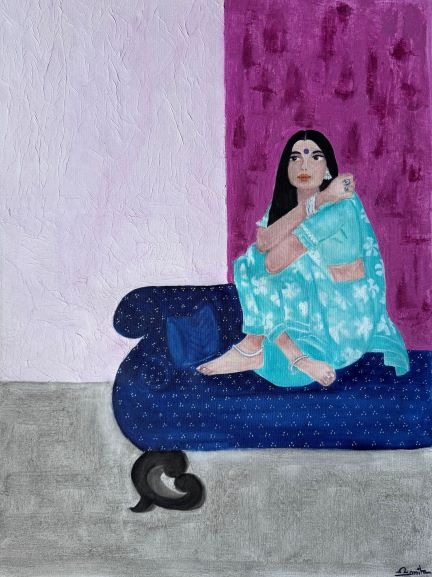
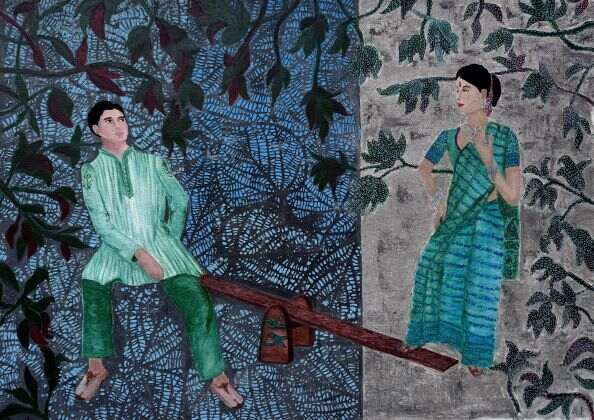
In “अंदरूनी सरहदें… Inner Frontiers”, Namita Prakash traces invisible boundaries that dwell within us—emotional, psychological, and spiritual terrains shaped by memory, identity, resilience, and hope.
Curated by Jitendra Padam Jain and presented by Gallery Sree Arts, the exhibition opens with a vernissage on 5th August, 4:00 pm at India International Centre Annexe, New Delhi, and welcomes visitors from 6th to 13th August 2026.
Namita Prakash’s canvases do not prescribe answers; they invite reflection. Nature, music, mythology and the feminine spirit converge in her works as symbols of strength and vulnerability, healing and renewal. Each painting becomes a quiet mirror, urging the viewer to pause and rediscover forgotten memories or moments of stillness.
Her journey across India, Singapore, and Qatar has infused her practice with textures of belonging and transformation. Domestic silences, festival colours, desert vastness, and multicultural rhythms have all left emotional residues that now surface in layered forms and symbolic elements. What emerges is not geography but an inner cartography—maps of silence, resilience, and identity.
“The exhibits celebrate the strength of silence. Namita’s paintings remind us that the most profound frontiers are not on maps but within us. This exhibition is our ode to introspection, healing and the feminine spirit.” — Ankush B. Sharma, Co‑Founder, Gallery Sree Arts
Namita Prakash believes abstraction is not more complex than landscape or figurative art—it simply speaks in a different tongue. A landscape may feel instantly familiar, while abstraction stirs memory, intuition, and emotion. For her, the depth of art lies not in style but in the dialogue it creates with the viewer.
She sees sculpture and installation as languages of space and body, extending beyond the canvas. Unlike painting’s illusion, they inhabit real space, inviting participation and immersion. Contemporary art, she feels, has expanded into light, sound, textiles and technology—mediums matter less than authenticity of concept. In terms of appreciation –sculpture and installation are gaining increasing recognition, particularly through museums, biennales and art fairs.
Commercially, she observes a growing demand for sculpture and installation in corporate, public, and luxury spaces. Their value, like all art, rests on originality, craftsmanship, and conceptual depth.
Each country, she notes, nurtures its own artistic ecosystem. India’s heritage pulses with diversity and fearless experimentation, while Singapore offers a highly organised, globally connected framework—an essential gateway between Asia and the world.
Qatar, with its museums and public art, has emerged as a cultural beacon in Western Asia. For Namita Prakash, living there revealed the power of silence, space, and the dialogue between tradition and modernity. India gave her roots and visual language, Singapore broadened her horizons, and Qatar deepened her sensitivity to emptiness and resilience.
She believes the strength of an art scene lies not in its market alone but in its ability to inspire, engage, and create meaningful conversations.
Her admiration spans across artists—S.H. Raza’s spiritual geometry, Tyeb Mehta’s emotional intensity, Arpita Singh’s layered narratives, Rothko’s contemplative colour fields, Anish Kapoor’s sculptural poetics, and Steve McCurry’s human dignity. Each has expanded her understanding of what art can communicate.
Globally, she sees art appreciation thriving where education and institutions nurture audiences—Italy and France with their heritage, the UK and US with vibrant ecosystems, Japan with its devotion to craft, Singapore with its cultural exchange, and Qatar with its bold investments.
“India occupies a unique place. It possesses one of the world’s richest artistic and cultural traditions, where the contemporary art ecosystem is evolving. Encouragingly, there is growing awareness among younger audiences, an expanding collector base and increasing support from galleries, institutions and art fairs,” and India, Namita feels, is at an exciting juncture, where tradition and contemporary voices converge with growing energy.
Her own practice begins with human experience. Power, for her, is resilience and compassion; femininity is grace and renewal. Women in her paintings embody strength, vulnerability, and transformation. She believes in the emotions that connect us all — joy, solitude, hope, belonging and the search for inner peace.
Music threads through her canvases—ektara, sitar, damru—symbols of rhythm and inner voice. These elements do not mix by design; they flow together naturally, as they do in life.
Though shaped by many lands, she chose India to present “अंदरूनी सरहदें… Inner Frontiers”. Its language is Indian, yet its emotions are universal—identity, belonging, resilience, and the inner self. For Namita, this is only the beginning; she hopes the exhibition will travel beyond borders, carrying its quiet maps of humanity to the world.
For Namita Prakash, art begins and ends with the human experience — the quiet emotions, fragile memories, and unseen transformations that shape our inner lives. “अंदरूनी सरहदें… Inner Frontiers” is her way of giving these silent narratives a visual language, mapping the borders of identity, resilience, and hope.
Her paintings do not seek to answer; they invite pause. Nature, music, mythology, and the feminine spirit weave together as symbols of strength and renewal. Each canvas becomes a mirror, asking the viewer to listen inward.
If a work awakens a forgotten memory, stirs introspection, or simply offers a moment of stillness, then the exhibition has fulfilled its purpose.
In that quiet dialogue between art and self, Namita Prakash believes, lies the true frontier — not on maps, but within us.