Posted on 6 September 2026:
Shikshaguru Abanindranath: Dr. Soma Sen’s Illustrated Talk on Artist Abanindranath Tagore at Pondicherry, 7 September 2026
An Illustrated Talk on Abanindranath Tagore, Founder of the Bengal School of Art, at The Hall of Harmony, Pondicherry — Monday, 7th September 2026, 8.30–9.30 p.m.
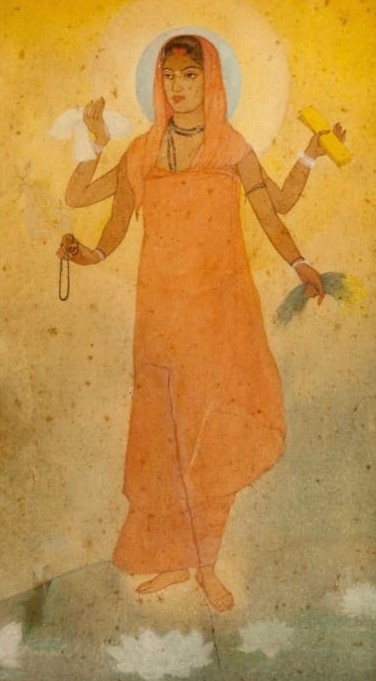
There are teachers who instruct, and there are teachers who awaken. Abanindranath Tagore belonged unmistakably to the second kind — a Shikshaguru in the truest sense, whose brush did not merely paint but taught an entire nation to see itself anew.
On the evening of Monday, 7th September 2026, from 8.30 to 9.30 p.m., The Hall of Harmony in Pondicherry will host a richly illustrated talk devoted to this remarkable artist-teacher, presented by the distinguished art historian Dr. Soma Sen under the evocative title “Shikshaguru Abanindranath: Abanindranath as the Art Teacher.”
THE ARTIST WHO FOUNDED A RENAISSANCE
Abanindranath Tagore, nephew of the poet Rabindranath Tagore, occupies a singular place in the history of modern Indian art. As the founder of the Bengal School of Art, he did far more than establish a movement — he kindled a renaissance of Indian culture and spiritual expression at a moment, in the early 1900s, when the subcontinent was searching for an artistic language distinctly its own. Where colonial academies had trained Indian artists to imitate Western realism, Abanindranath turned instead toward the wellsprings of indigenous tradition, Mughal miniature, Ajanta fresco, and Japanese wash technique, weaving them into a visual idiom that was at once ancient and startlingly new. In doing so, he did not simply create paintings; he created permission — permission for generations of Indian artists to root their imagination in their own soil.
Sri Aurobindo’s Tribute to a Living School
Few endorsements capture the spirit of this awakening as powerfully as the words of Sri Aurobindo, who recognised in Abanindranath’s circle not a solitary genius but the seed of a living, breathing school of thought. He observed that the artistic revival had been set into motion by a young and vigorous fellowship gathered around its master and originator, and that the recovery of India’s artistic past achieved through this school, along with its intuitive glimpses of the future, deserved to be carried to the people and embraced as a national inheritance.
It is a tribute that positions Abanindranath not merely as a painter of note, but as the wellspring of a cultural movement whose ripples were meant to reach far beyond the walls of any single studio.
DR. SOMA SEN: CHRONICLER OF THE QUIETLY DEVOTED
Guiding the audience through this legacy is Dr. Soma Sen, an art historian who has devoted many years to chronicling the lives of artists who deliberately chose the shadows over the spotlight — those who worked away from fame and glamour, absorbed instead in the quiet integrity of their craft. This sensitivity to overlooked brilliance makes her an especially fitting narrator for Abanindranath’s story, itself a tale of an artist who taught more than he sought applause. Intriguingly, Dr. Sen’s own scholarly life mirrors the very versatility she studies: alongside her research into art history, she teaches as a professor of chemistry at Brahmananda Keshab Chandra College in Kolkata, bringing to her art-historical work the same rigour, curiosity, and precision that mark a life spent in the sciences.
JOIN THE EVENING AT THE HALL OF HARMONY
Mark your calendars for Monday, 7th September 2026, between 8.30 and 9.30 p.m., at The Hall of Harmony, for a rare evening of insight and inspiration — a thoughtfully illustrated encounter with the man remembered as Shikshaguru, the teacher who taught India to paint its own soul.