Posted on 13 July 2026:
The Bondage of Soul in Śaiva Siddhānta: Dr. Murugesan A Illuminates the Depths of Āṇava Mala
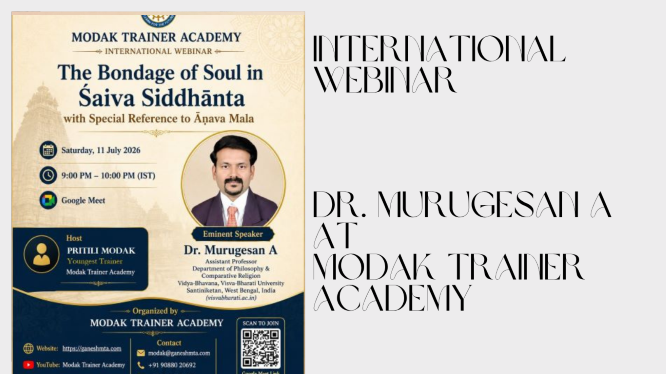
In a luminous international webinar hosted by Modak Trainer Academy, Kolkata, the timeless philosophy of Śaiva Siddhānta came alive through the erudite insights of Dr. Murugesan A, Assistant Professor at the Department of Philosophy and Comparative Religion, Visva‑Bharati University, Santiniketan.
The session, held on 11 July 2026, explored The Bondage of Soul in Śaiva Siddhānta with special reference to Āṇava Mala, revealing the subtle metaphysics that define the soul’s journey toward liberation.
Guided by host Pritili Modak, the youngest trainer of Modak Trainer Academy, the webinar unfolded as a contemplative dialogue between philosophy and spirituality.
Dr. Murugesan A traced the intricate layers of Āṇava Mala—the primal impurity that veils the soul’s innate purity—explaining how this concept bridges metaphysical thought and experiential realization. His discourse illuminated the eternal triad of Pati (Lord Śiva), Pasu (the soul), and Pāśa (bondage), inviting participants to reflect on the soul’s gradual awakening from ignorance to divine consciousness.
Foundational Concepts of Bondage in Śaiva Siddhānta: The Soul’s Journey Through Pāśa and Mala
In the luminous philosophy of Śaiva Siddhānta, the soul’s bondage is explored through a triad of eternal realities—Pati (Lord Śiva), Pasu (the soul), and Pāśa (bondage). This metaphysical framework reveals how impurity (Malam) acts as a subtle stain, veiling the soul’s original radiance and creating separation from the divine.
Philosophically, Pāśa signifies that which binds the soul, while functionally it is the impurity that obscures its innate purity. The tradition identifies three kinds of bondage—Āṇava Mala, the primal limitation; Karma Mala, the bondage of action; and Mayiya Mala, the illusion of the physical world.
Brief yet profound, these concepts form the foundation of Śaiva Siddhānta’s vision of liberation: the gradual unveiling of the soul’s true nature, where every impurity dissolves into the infinite grace of Pati
Anava Mala: The Primal Veil of Consciousness in Śaiva Siddhānta
In the luminous philosophy of Śaiva Siddhānta, Anava Mala is revered as the most fundamental form of bondage—the subtle veil that dims the soul’s innate brilliance. Derived from Anu (soul) and Aavum (reducing), it signifies the soul’s descent from its original state of full knowledge and freedom into limitation and obscurity.
According to the Sivagnana Bodham, this mala clouds awareness, separating the soul from its natural purity and divine union with Lord Śiva. Its influence unfolds through seven veils—confusion (Marul), darkness (Irul), desire, ego, ignorance (Avidya), infatuation (Moha), and non‑satisfactoriness. Each veil binds the soul deeper into illusion, obscuring its perception of truth.
Brief yet profound, the study of Anava Mala reminds seekers that liberation begins with clarity—when the soul, freed from confusion and desire, rediscovers its eternal harmony with the divine.
The event resonated with the Academy’s guiding ethos—Learn, Reflect & Realize—as scholars and seekers joined across continents via Google Meet to engage with India’s profound philosophical heritage.
The evening became a celebration of wisdom, where ancient thought met modern inquiry, and the universal quest for truth found new expression through dialogue.
THIS INTERNATIONAL WEBINAR STANDS AS A RADIANT MILESTONE IN CROSS‑CULTURAL LEARNING, REAFFIRMING THAT THE STUDY OF ĀṆAVA MALA IS NOT MERELY AN ACADEMIC PURSUIT BUT A SPIRITUAL INVITATION—TO CLEANSE, TO AWAKEN, AND TO REALIZE THE BOUNDLESS FREEDOM OF THE SOUL.