Posted on 12 July 2026:

Hemraj and the Philosophy of Dissolutionism: Monumental Abstractions in Indian Contemporary Art
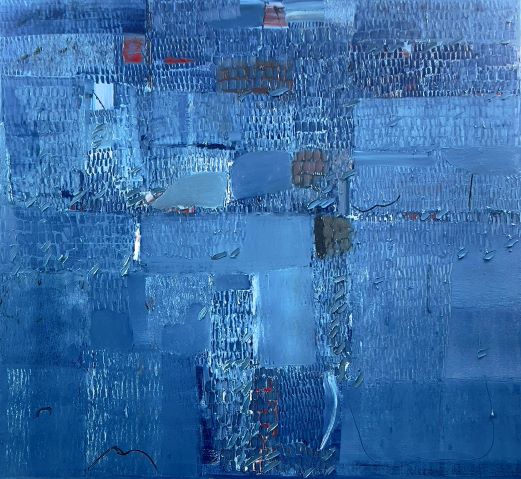
Eminent artist Hemraj stands as a colossus in the domain of Indian contemporary art. His monumental abstract paintings are revered for encapsulating the quintessence of his unparalleled vision—a testament to his profound comprehension of abstraction and the intricacies of human emotions.
Hemraj’s decades‑long journey is suffused with philosophical and spiritual undertones, echoing the quiet depth of Buddha’s teachings. His canvases breathe with ethereal multiplicity, where organic forms refuse to become mere symbols or coded messages.
Each form possesses independence, yet participates in a larger unity, transforming perception itself.
Sharing his philosophy with the magazine, Hemraj reflects:
“For more than a century, contemporary painting has repeatedly reinvented itself. It has abandoned realism, embraced abstraction, explored conceptualism, questioned representation, and challenged the very definition of art. Yet through all these transformations, one assumption has remained remarkably constant: a painting is expected to express something… Indian contemporary artist Hemraj questions this foundation. His philosophy, Dissolutionism, does not ask what a painting expresses. Instead, it asks what happens when expression itself is no longer the destination.”
For Hemraj, the deepest encounter with art occurs not when the viewer understands, but when the need to understand dissolves. His works do not merely occupy walls—they transform the quality of perception. It should transform the quality of perception.
Rooted in the Buddhist precept of inner emptiness and detachment, his philosophy invites the viewer into silence, where abstraction becomes not explanation, but experience.
Eminent artist Hemraj speaks of vision as dissolution, of perception stripped bare. He reflects:
“The mind initially attempts to organize the image, searching for familiar patterns and recognizable meanings. It compares, categorizes, and interprets.
Eventually, however, the sheer abundance of visual relationships exhausts these habits. Interpretation slows. Judgment becomes less important. Attention becomes effortless. What remains is pure looking. This moment is the heart of Dissolutionism.”
“The painting has not changed. The viewer has. The work no longer functions as an object demanding explanation but as a living field in which awareness begins to observe itself.
In this state, the traditional distinction between artist, artwork, and audience becomes less rigid. The painting is no longer something outside consciousness. It becomes part of consciousness itself.” – he says.
For Hemraj, painting is not a mystical ritual nor a therapeutic exercise—it is a shift in perception, a way of seeing that precedes language, opinion, and interpretation. His philosophy of Dissolutionism distinguishes itself from other currents of abstraction by refusing the pursuit of emotional intensity, formal innovation, or conceptual inquiry. Instead, it proposes a subtler ambition.
Hemraj reflects:
This distinguishes Dissolutionism from many currents of abstraction. Where some abstract painters seek emotional intensity, and others pursue formal innovation or conceptual inquiry, Hemraj proposes an entirely different ambition.
“The purpose of painting is neither to impress nor to persuade.
Its purpose is to dissolve the invisible distance that separates observer and image.
In this philosophy, beauty is not decoration.
Complexity is not confusion. Silence is not emptiness. Each becomes a condition through which perception can become free from its habitual divisions.
Dissolutionism therefore introduces a new possibility for contemporary painting.
Art need not always communicate. Sometimes its greatest achievement is to create a space where communication is no longer necessary.
The painting neither answers questions nor raises new ones. It simply invites presence.
In a culture increasingly dominated by speed, distraction, and constant explanation, Hemraj’s work reminds us that the most profound experiences often occur before words arise.
Dissolutionism is therefore more than a personal artistic practice.”
He elaborated his vision:
“It is a proposal for a different relationship between human consciousness and visual art. Not a philosophy of expression.
Not a philosophy of representation. But a philosophy of direct experience. In Hemraj’s paintings, the image does not seek attention.
It invites absorption. And when the viewer no longer stands outside the painting, the work reaches its final completion—not on the canvas, but within consciousness itself.
Hemraj’s Dissolutionism leaves us not with answers, but with the quiet gift of pure presence.”