Posted on 3 June 2026:
Birendra Pani’s Neo-Urban Avatar: A Mythopoesis of Contemporary Times-II
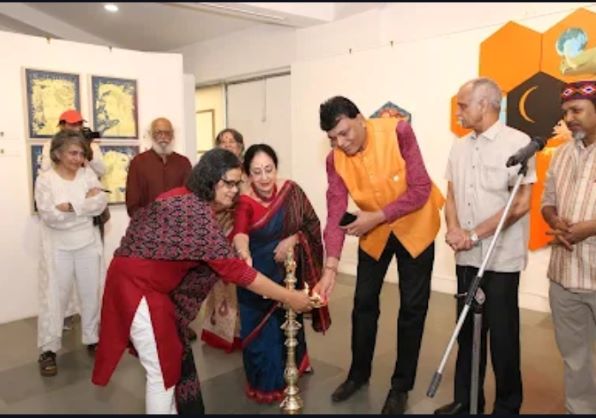
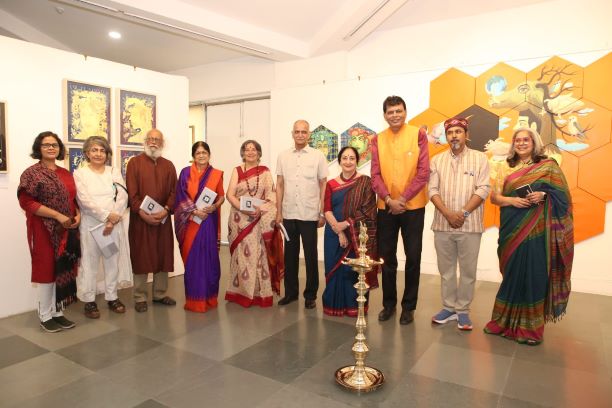
On 30th June 2026, the India International Centre Art Gallery at the Kamala Devi Complex, New Delhi, became the stage for an extraordinary cultural moment. Neo-Urban Avatar: A Mythopoesis of the Contemporary Times-II, the 16th solo exhibition of internationally acclaimed contemporary Indian artist Birendra Pani, was inaugurated with grandeur and intellectual resonance.
This exhibition, a continuation of Birendra Pani’s mythopoetic exploration of urban realities, reflects the pulse of contemporary society through his unique artistic lens.
Eminent Voices at the Inauguration
The inaugural ceremony was graced by distinguished luminaries from diverse disciplines. Among them were art historian Prof. Parul Dave Mukherji (Dean, School of Arts & Aesthetics, JNU), art historian and curator Dr. Rajashree Biswal, artist and Padma Bhushan awardee Jatin Das, art consultant Sushma Bahl, Odissi dancer Sharon Lowen, poet and former Secretary, MEA Amarendra Khatua, historian Nibedita Mohanty, and former IPS officer Sanjeeb Patjoshi. The program was elegantly facilitated by Radhika Dhumal, Trustee of Purushottam Public Trust.
A Gathering of Minds
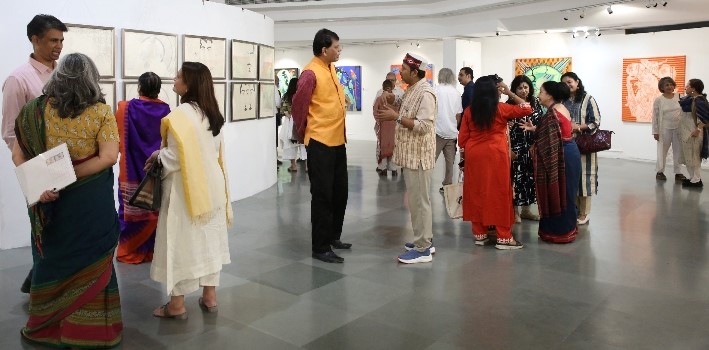
The exhibition drew an audience that extended beyond the art fraternity, welcoming scholars, diplomats, performers and admirers from varied disciplines. Their presence underscored the universal appeal of Birendra Pani’s work—art that transcends boundaries and speaks to the shared mythologies of modern urban existence.
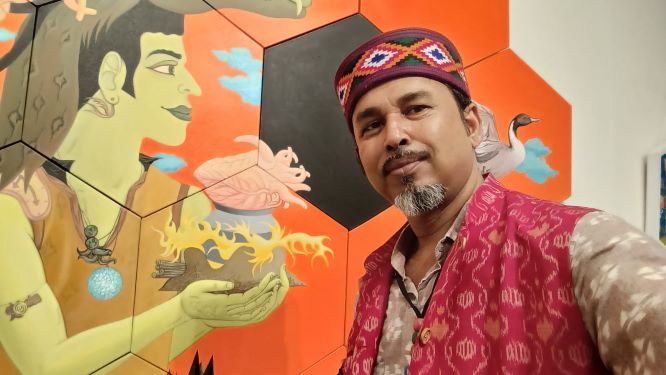
In his 16th solo exhibition, Neo-Urban Avatar: A Mythopoesis of the Contemporary Times-II, Birendra Pani’s thirty-five years of artistic engagement into a luminous showcase of eighty works. The exhibition spans across his celebrated Neo-Urban Avatar Series, the poignant Sanguine Story Series, the intimate 365 Days Series of drawings, the evocative Day Dreaming in Vadodara Series of prints, and other creations rooted in everyday life. These art works resonate with the tension, contradictions and struggle of contemporary human life due to the effect of globalization, hypermodern consumerist culture, ecological concerns and negligence of local history, and memory. His artistic expressions are a blend of globalization’s visual culture and the timeless cadence of Indian aesthetic traditions.
“My constant relocation to different places propelled me to experiment with the iconographic elements of the Patta Chitra and palm leaf drawings, the monumental architectural and sculptural tradition, folk and performing dance tradition, and popular art of my native state of Odisha and thus, to reinvent my ‘self’ in a globalizing world.” — Birendra Pani
For Birendra Pani, Neo-Urban Avatar is not merely a series but an imaginary conceptual expression—a radiant metaphor for “the essence of the positive spirit and hope within us” to endure and flourish in hypermodern times.
Birendra Pani: Thirty-Five Years of Global Visual Dialogues
Educated at the revered art institutions like Kala Bhavan, Santiniketan of Visva Bharati University and MS University, Vadodara, Birendra Pani has carved a luminous path in the world of visual arts. Over thirty-five years, he has lived and worked across Vadodara, Mumbai, Delhi and Odisha, weaving experiences into a rich artistic tapestry. His journey has taken him to solo exhibitions in New York, San Diego, Malaysia, and across India, while his works have graced more than 350 group exhibitions worldwide.
Birendra Pani’s artistry has been recognized with the Junior and Senior Fellowships from the Ministry of Human Resource Development, Government of India, alongside national and state-level awards, including the Print Making Award from South Central Zone Cultural Centre, Nagpur, and multiple honors from the Odisha State Lalit Kala Academy. Beyond his personal practice, he co-founded the non-profit cultural initiative New Bridge India with Dr. Rajashree Biswal, founder, dedicated to bridging gaps between ideas, persons, space, place, communities and institutions through art and dialogue.
Birendra Pani’s journey is not only a chronicle of accolades and exhibitions but also a testament to art’s power to connect worlds, traditions, and communities with grace and vision.
Dialogues with Luminaries
To further decipher the significance of the art exhibition, a discussion on this art exhibition will be held on 11 July 2026 @ 5 P.M, with Sushma Bahl (Art writer & Curator), Dr. Seema Bawa (Art Historian), Georgina Maddox (Art Critic & Curator), Birendra Pani (Contemporary Visual Artist) and Radhika Dhumal (Purushotham Public Trust) as the Panellists.
Organized by the India International Centre (IIC) Art Gallery in collaboration with the Purushottam Public Trust, the exhibition runs from 1st July to 14th July 2026.
For Birendra Pani, art becomes his bridge—between tradition and an opportunistic tomorrow, between Odisha and the world.