Posted on 14 May 2026:
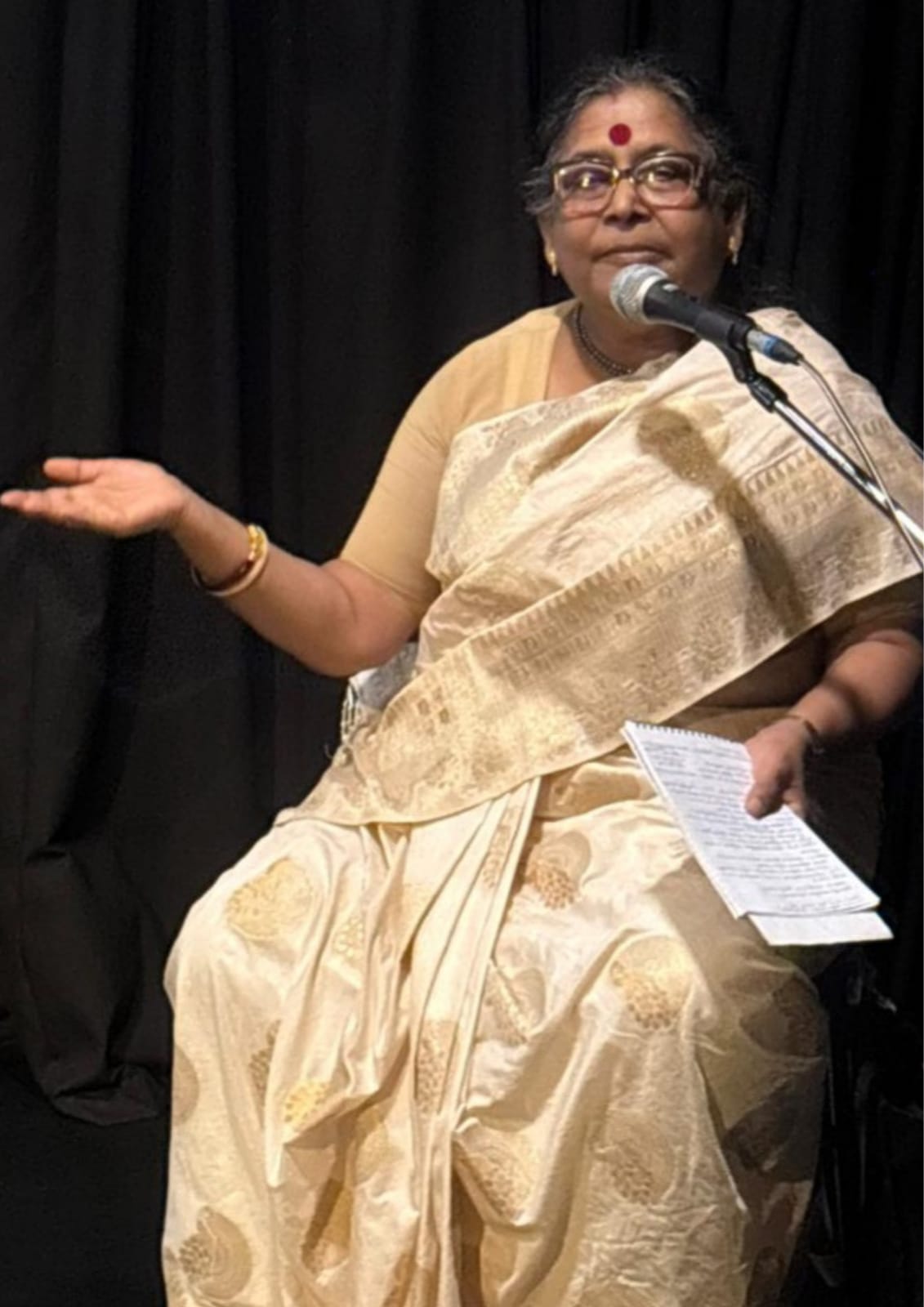
Dance & Tagore: Dr. Mahua Mukherjee’s Illuminating Lecture at Anuchintan Art Centre
On 9th May 2026, the Anuchintan Art Centre, Kolkata became a sanctum of rhythm and thought as Kasba Arghya, Kolkata commemorated the 165th Birth Anniversary of Rabindranath Tagore with a profound Lecture–Demonstration by Dr. Mahua Mukherjee.
Titled Dance & Tagore, the evening blossomed as a dialogue between philosophy and movement, enriched by the artistry of Dr. Soumya Bhowmick, Ranjima Chatterjee, Monikiran Duttagupta, and Shrimoyi Mistri, while Pandit Amitava Mukherjee lent his resonant voice and designed evocative presentations that illuminated the stage with beauty and thought.
The recitation of Karnakunti Sangbad in Hindi translation by Little Thespian added a dramatic cadence, complemented by the presence of renowned contributors such as Manish Mitra, Sima Ghosh and the audio dramas Dakghar and Raktakarabi. The evening’s tapestry was further adorned by the soulful singing of Shibaprasad Bhowmick, weaving Tagore’s timeless words into melody.
Together, these voices and movements created not merely a commemoration, but a living dialogue — where Tagore’s vision of art as philosophy found new resonance in dance, drama, and song.
Dr. Mukherjee’s eloquence revealed Tagore not merely as a literary genius but as a visionary who understood rhythm as the pulse of existence.
“The world may know Tagore through his immortal literature, yet he was equally a genius of dance and music—arts born from the very rhythm of his words. For him, rhythm was not ornament but philosophy: the cadence of joy, the pulse of life, the heartbeat of India. He believed that music and fine arts are the truest media of national self‑expression, for without them a country remains voiceless. Worshipping rhythm, Tagore established the dance of India—where literature, melody, and movement converge into the nation’s living soul.”
“Music and Fine Arts are the best media of national self-expression,” she reminded, echoing Tagore’s conviction that a nation without art remains voiceless.
She traced how Rabindranath Tagore, worshipper of rhythm, created the cadence of joy, the rhythm of life, and the dance of India itself.
Her lecture painted vivid historical contrasts—how dance, once confined to the courts of Nawabs and degraded into entertainment for the colonial elite, had lost dignity in society. Against this backdrop, Tagore’s pioneering vision shone: through Santiniketan (1901) and later Visva-Bharati (1921), he established institutions where dance, music, and fine arts became integral to education and cultural identity. His efforts inspired the founding of Kerala Kalamandalam and Kalakshetra, sowing seeds for India’s modern cultural renaissance.
Dr. Mukherjee recalled the turning point of 1926, when Tagore staged Natir Puja with dance, awakening Calcutta’s enlightened circles to its hidden treasures. From then, barriers began to dissolve—respectable families allowed daughters to embrace dance, and the art reclaimed its dignity. Tagore’s reflections on rhythm and gesture, his belief that dance is a moving art form of the body, unveiled a new horizon for Indian expression.
“Rabindranath Tagore unveiled a new horizon in Indian dance, elevating both classical and folk traditions to dignity and recognition. For him, fine arts were not mere embellishments but essential to education and national self‑expression. Even as a young student in England, he absorbed the rhythms of social dances like the Lancer and Gallop, and upon returning, choreographed ‘Ay Tabe Sahochori’ for his drama Manmoyi. In this way, Tagore bridged cultures, popularized local forms across India and abroad, and revealed dance as a universal language of rhythm and life.”
The evening was not only a tribute to Tagore’s legacy but also a reminder of his internationalism—his embrace of both Indian classical and folk traditions alongside foreign forms, choreographing even in the style of English social dances he once learned.
THROUGH LECTURE AND DEMONSTRATION, DR. MAHUA MUKHERJEE ILLUMINATED HOW TAGORE’S VISION TRANSFORMED DANCE FROM MARGINALITY TO REVERENCE, FROM SILENCE TO RHYTHM, FROM ISOLATION TO UNIVERSALITY.