Posted on 20 August 2026:
Anandamela 2026: A Soulful Solo Instrumental Concert Honours Pandit V. G. Jog at Surya Sen Mancha, Kolkata
Tapas Kumar Pal Academy of Music and Cultural Foundation pays tribute to the violin legend with an evening of violin, sitar and esraj recitals.
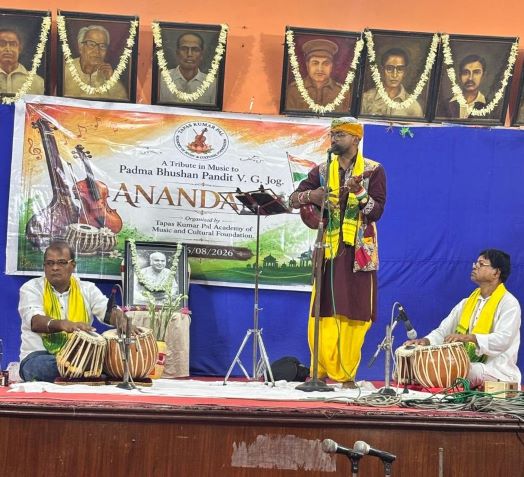
On the quiet evening of Sunday, 16 August 2026, the Pandit V.G. Jog Stage at Surya Sen Mancha in Kolkata turned into a sanctuary of strings. The Tapas Kumar Pal Academy of Music and Cultural Foundation brought together generations of instrumentalists for “Anandamela” — literally, a “fair of joy” — a solo instrumental concert conceived as a heartfelt tribute to Padma Bhushan awardee Pandit V. G. Jog, whose name remains inseparable from the Indian classical violin.
An Evening That Began With Light and Remembrance
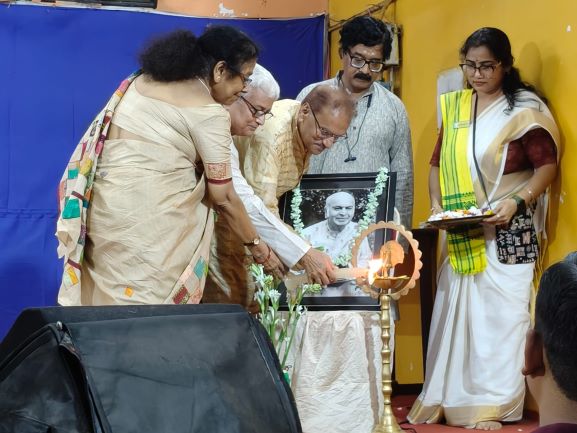
Before a single note was played, the hall paused for reverence. Flowers were laid at the portrait of Pandit V. G. Jog, and the ceremonial lamp was lit by the Academy’s Executive President Dr. Sankar Chakravorty, Vice President Gayatri Bhattacharya, and Advocate Pradip Majumdar.
A short inaugural address followed, framing the evening not merely as a performance, but as an act of cultural continuity — a reminder that the stage itself is often a young artist’s first true teacher.
Where Young Talent Took Its First Bow
True to its purpose of nurturing the next generation, Anandamela opened its doors to its youngest performers first.
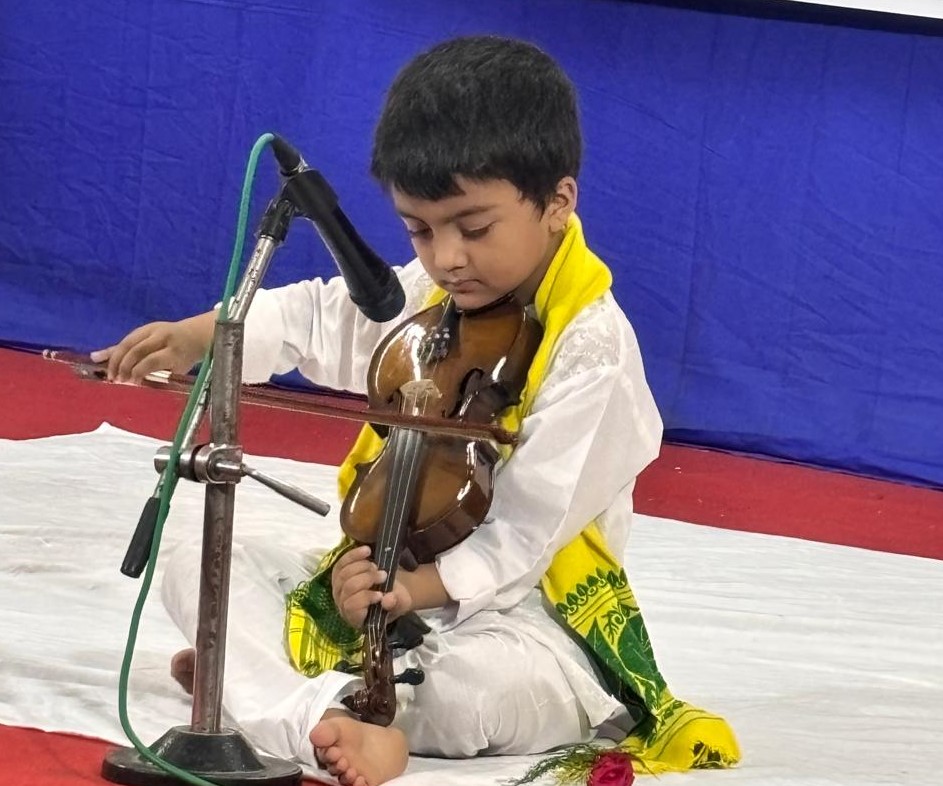
Six-year-old Purvik Majumdar, a first-grader taking his place on a concert stage, began the program with Rabindranath Tagore’s “Anandoloke,” his composed delivery drawing warm applause from an audience charmed by his poise. He was followed by young Swarnadeep Hazari, who offered a companion song on the behala (violin) — a gentle passing of the torch between the evening’s smallest performers and the masters who would follow.
The Violin Takes Centre Stage
As the evening deepened, the violin — or behala, as it is affectionately called in Bengal — asserted itself as the true protagonist of the night, with tabla accompaniment lending rhythm and gravity to each rendition.
Suptotthita Mukherjee opened this stretch of the program with Raga Kafi, accompanied by Samir Lal Ghosh on tabla, whose partnership continued through several recitals across the evening. Ananyarup Haldar followed with his own interpretation of Raga Kafi, while Sanjay Roy brought forth the lyrical Raga Brindabani Sarang set in jhaptal.
The Academy’s own Executive President, Professor Dr. Sankar Chakravorty, stepped forward with a ragmala — a garland of ragas woven into a single recital — showcasing both scholarship and command over the instrument. Aeindrita Sinha offered the tranquil Raga Bhupali, and Dr. Chiranjeeb Dey brought the shimmering colours of Raga Kalavati.
A particularly cherished moment arrived when the Academy’s President, Subhas De Niyogi, performed a beloved thumri — “Kakru Sajani” — before easing into a well-loved Bangla song, accompanied by Madan Chakraborty on tabla. It was a passage that blurred the line between classical rigour and folk warmth, much in the spirit of the man the evening honoured.
Strings Beyond the Violin: Sitar and Esraj Recitals
Anandamela’s canvas widened further with the introduction of the sitar and the esraj, instruments that lent the evening new textures and tonal depth.
Anindita Seal presented Raga Kirwani in teental on the sitar, with Ratna Chatterjee on tabla, while sitarist Tapan Bandyopadhyay later delivered a meditative Raga Malkaush, also accompanied by Ratna Chatterjee. On the esraj, Moumita Chowdhury explored Raga Bilaval, Pauli Chakraborty rendered the solemn morning raga Bhairav, and Subhra Majumdar turned to Rabindra Sangeet with “Koto Baro Bhebechinu.” Debasree Goswami closed this esraj segment with two Tagore compositions, “Tumi Robe Nirobe” and “Eso Eso Amar Ghore Eso,” each accompanied by Mangal Das on tabla.
An Unbroken Chain of Violin Artistry
The violin returned repeatedly through the night, each artist bringing a distinct temperament to the instrument. Anup Kumar Biswas performed Raga Tilak Kamod; Shakyasingha Majumdar offered Raga Alaia Bilaval; and Srijan Sinha presented Raga Khamaj, all accompanied variously by Mangal Das and Samir Lal Ghosh on tabla.
Ashrika Chakraborty combined a leisurely, drut-paced rendering of Raga Des with a kirtan-flavoured piece in Kafi, while Moumita Ghosh revived “Mayer Deoya Mota Kapor”–a bengali patriotic songwritten and composed during the Swadeshi Movement, by the renowned poet and lyricist Rajanikanta Sen, a song traditionally attributed to Rabindranath Tagore’s mother — a rare and touching addition to the evening’s repertoire.
Pallabita Chatterjee brought Raga Humbir to the stage with Agradeep Samanta on tabla, and Sayandeep Kundu followed with a striking Raga Behag, beginning in a slow dhamar tala before accelerating into a spirited teentaal finale. Adrita Ghosh mirrored this arc with her own performance of Raga Des, moving from a measured vilambit opening to a brisk teentaal passage, rounded off with a kirtan-style piece.
Among the evening’s most accomplished young performers, Adrish Nandy delivered a compelling Raga Emon in teental, accompanied by the celebrated tabla player Pandit Raghunath Nandi — a moment widely regarded as one of the night’s high points.
A Finale Rooted in Devotion and Folk Melody
As Anandamela drew to a close, the mood shifted from classical exposition to devotional and folk resonance.
Professor Subrata Natta took the stage with his distinctive voice, offering “Guru Vandana,” “Amar Vitor Bahire,” and finally “Hare Krishna Hare Ram,” with tabla support from both Samir Lal Ghosh and Mangal Das — a fitting, spirited conclusion to an evening built on reverence and renewal.
What distinguished Anandamela was not scale but sincerity—placing six‑year‑olds beside maestros, it honoured Pandit V. G. Jog’s violin legacy as a living bridge between tradition and tomorrow.
Anandamela—a living bridge linking the golden era of Indian classical violin with the young hands now carrying it forward.