Posted on 26 November 2026:
🎨 #YathraPulse
Anirban Returns to the Big Screen: Utpal Datta on Why Art Must “Elevate Humanity”
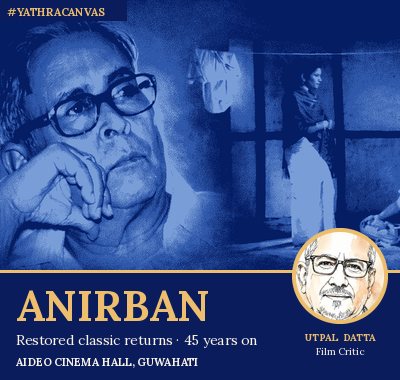
Restored Assamese classic by Dr. Bhabendra Nath Saikia premieres at Guwahati’s Aideo Cinema Hall, 45 years after its release
Some frames refuse to fade. On Tuesday evening, one of Assamese cinema’s most cherished films returned to the dark of a cinema hall, restored and luminous.
Forty-five years after its 1981 release, Anirban, directed by the legendary Dr. Bhabendra Nath Saikia, had the world premiere of its restored version at Aideo Cinema Hall, Guwahati. The screening was organised by the Film Heritage Foundation as part of the 11th Film Preservation & Restoration Workshop India 2026. The restoration itself was undertaken by the National Film Archive of India.
A Film That Travels Through Time
Dr. Bhabendra Nath Saikia adapted Anirban from his own 1960 short story Prahari. The film was made in 1980 and released in 1981.
National Film Award-winning critic Utpal Datta, Professor at Assam Downtown University, delivered the introductory speech. He spoke of a good film as something that never belongs to one era alone. It keeps travelling, finding new audiences and acquiring new meanings.
Renowned Prof. Utpal Datta thanked the Film Heritage Foundation and the NFAI, and recalled writing several times to Prakash Magdum to urge the film’s restoration. He also remembered two Guwahati locations seen in the film that have since vanished. One was the old Assam-type house at Bharalumukh, belonging to the literary personality Harendra Nath Kalita, which appears as Rajani Master’s home. “A house may disappear from the physical landscape, but cinema can preserve its memory,” he said. “The house is gone, perhaps, but its image remains. It has become part of our visual heritage.”
He also shared a playful anecdote about Rajani Master’s growing beard, which by the end gives him almost the look of a saint. Datta once asked Saikia about its resemblance to a character in the novel Ramyabhumi. The filmmaker only smiled. Datta kept the reply a secret, calling it “a possible spoiler.”
Reflecting on the experience of revisiting a film, Datta said: “Cinema does not end with the conclusion of a screening. It continues to live through memories, conversations and the questions it leaves behind”.
“Film restoration is not merely a technical exercise involving the repair of damaged images or the recovery of lost sound. It is fundamentally about preserving a filmmaker’s artistic vision and making it accessible to generations who were not present when the film was first released,” he added.
The Purpose of Art
The heart of the address was a simple question: what is the purpose of art? “For me, Anirban offers a beautiful answer,” Datta said. “At its finest, art has the power to elevate humanity. It makes us more sensitive, more compassionate and perhaps a little more humane.” He added that restoration is more than repairing images and recovering sound. It preserves a filmmaker’s vision for generations who were not there at the beginning.
Welcoming the audience on behalf of the Film Heritage Foundation, Sibendra Singh Dungarpur noted that viewers still hunger for meaningful old films, but rarely get to see them on the big screen. Actress Bobeeta Sarma, who worked in the film, shared her memories of the shoot.
More than a nostalgic evening, the screening reaffirmed the value of preserving Assamese cinema’s heritage. For a new generation of viewers, students and researchers, the restored Anirban is an invitation to rediscover a film whose humane concerns still ring true.
🎨 #YathraPulse: